B 1/7 Mahanagar Extension ( Opp. Sahara India Centre ), Kapoorthala, Lucknow - 226006

Mon - Sat: 10:00am to 8:30pm
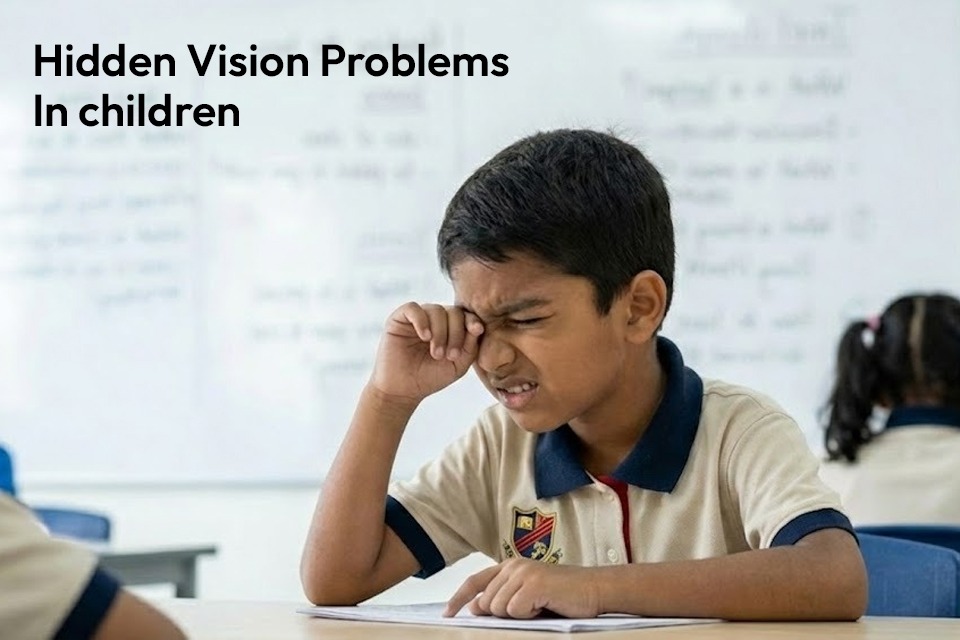
As a parent, you watch every step your child takes, making sure they are healthy, happy, and growing well. You take them for regular vaccinations and dental check-ups, but how often do you think about their eye health?
One of the biggest challenges with children's eye care is that children rarely complain about poor vision. Why? Because they simply do not know what "normal" vision is supposed to look like. If the whiteboard at school looks blurry to them, they might assume it looks blurry to everyone else. They adapt to their poor vision, and as a result, many vision problems go completely unnoticed by both parents and teachers.
Healthy eyes are critical for a child's development. In fact, experts estimate that up to 80 percent of everything a child learns in their early school years is presented visually. If a child cannot see clearly, they cannot learn easily. As a leading eye hospital in Lucknow, we want to help you spot the early warning signs of eye issues so you can protect your child's future.
Here are the 7 silent signs that your child might have a hidden vision problem.
1. Frequent Eye Rubbing
It is normal for a child to rub their eyes when they are feeling sleepy or right after they wake up. However, if you notice your child rubbing their eyes constantly throughout the day—especially while reading, doing homework, or watching television—it is a major red flag.
Frequent eye rubbing is often a sign of eye strain or eye fatigue. When a child has an uncorrected vision problem, their eye muscles must work extra hard to focus on objects. This constant effort causes discomfort, leading the child to rub their eyes for relief. In some cases, frequent rubbing may also indicate allergic conjunctivitis, which requires medical attention.
2. Squinting or Tilting the Head
Have you noticed your child squeezing their eyes partially shut when trying to see something far away, such as the television or a street sign? This behavior, known as squinting, temporarily changes the shape of the eye and blocks excess light, slightly improving focus for someone with blurry vision.
Similarly, some children may consistently tilt their head to one side or cover one eye when focusing. This often indicates that one eye has stronger vision than the other or that the child may have astigmatism—an irregular curvature of the eye that causes distorted vision. Tilting the head helps them find an angle where the image appears clearer.
3. Sitting Too Close to Screens or Books
This is one of the most common and easily recognizable signs of a vision problem. If your child frequently sits very close to the television, holds a tablet or phone just inches from their face, or lowers their head close to the desk while doing homework, they may be experiencing myopia.
Myopia, also known as nearsightedness, allows a person to see nearby objects clearly while distant objects appear blurry. Children with myopia instinctively bring objects closer to make them appear sharper. If you ask your child to move back from the television and they slowly inch forward again, it is a strong indication that an eye examination is needed.
4. Frequent Headaches or Eye Pain
If your child frequently complains of headaches—especially in the afternoon or right after returning from school—do not ignore it. While headaches can be caused by factors such as dehydration or lack of sleep, they are also a very common symptom of vision problems.
When a child has farsightedness (hyperopia) or astigmatism, their eye muscles must constantly strain to keep words and images in focus. After hours of reading or looking at the classroom board, this strain can result in throbbing headaches, often felt around the eyebrows or the front of the head. If your child mentions that their eyes hurt or feel “heavy,” an eye specialist should evaluate them.
5. Losing Place While Reading or Using a Finger to Guide
When children first learn to read, it is completely normal for them to use their finger to follow words on the page. However, as they grow older and become more confident readers, they should be able to track text smoothly using only their eyes.
If an older child still relies heavily on their finger, frequently loses their place, skips lines, or rereads the same line multiple times, it may indicate a problem with eye tracking or eye coordination. This means the eyes are not working together effectively, making reading tiring, slow, and frustrating.
6. Avoiding Reading or Close Work
Children naturally gravitate toward activities they enjoy and avoid those that cause discomfort. When a child has an undetected vision problem, tasks such as reading, solving puzzles, or doing crafts can cause physical strain and eye discomfort.
If your child once enjoyed reading but now avoids it, becomes irritable, throws tantrums, or refuses homework, do not immediately assume laziness or stubbornness. They may be avoiding close work because their eyes hurt or the letters appear blurry, jump around, or overlap.
7. Poor School Performance or Lack of Concentration
Many children with undiagnosed vision issues are mistakenly labeled as having learning disabilities or Attention Deficit Hyperactivity Disorder (ADHD). From a child’s perspective, not being able to see the board clearly can quickly lead to boredom, distraction, and loss of focus.
Before assuming a behavioral or learning issue, it is crucial to rule out vision problems. A sudden drop in academic performance or teacher feedback about inattentiveness may simply mean your child cannot see well enough to engage fully in the classroom.
The Danger of the "Silent" Eye Problem: Lazy Eye (Amblyopia)
One of the most critical reasons to watch for these signs is to prevent a condition called Amblyopia, commonly known as "Lazy Eye."
Lazy eye happens when there is a breakdown in how the brain and the eye work together. If one eye has significantly worse vision than the other (due to high refractive error or an eye turn/squint), the brain will start to ignore the blurry picture coming from the weaker eye. Over time, the brain will only rely on the strong eye.
If left untreated, the weaker eye can permanently lose its ability to see, even with glasses. As a Vitreo Retina Specialist, Dr. Mohit Khemchandani understands exactly how the eye sends visual signals to the brain. Treating lazy eye is highly successful if caught early in childhood, usually through prescription glasses or by putting an eye patch over the strong eye to force the brain to use the weak eye. However, if lazy eye is not caught before the age of 8 or 9, the vision loss can become permanent.
School Vision Screenings Are Not Enough
Many parents believe that because their child passed a basic eye test at school, their eyes are perfectly fine. This is a dangerous misconception.
School vision screenings usually only test for one thing: distance vision (reading letters off a chart on the wall). They do not test for eye health, eye coordination, focusing ability, color blindness, or how the eyes function at a reading distance. A child can pass a school screening with "20/20" vision but still suffer from severe eye strain, astigmatism, or a lazy eye. Only a comprehensive medical eye exam by a qualified eye specialist can detect these hidden problems.
How Digital Screens Are Making Things Worse
Today's children are growing up in a digital world. From online classes to mobile games, their eyes are constantly glued to screens. Prolonged screen time is causing a massive rise in childhood myopia and digital eye strain.
When children stare at screens, they blink less often, leading to dry and irritated eyes. The constant close-up focus also fatigues the eye muscles. We highly recommend following the "20-20-20 Rule" for your children: for every 20 minutes of screen time, make them look at something 20 feet away for at least 20 seconds. This simple habit gives their eye muscles a much-needed break.
When Should You Get Your Child’s Eyes Checked?
You do not need to wait for your child to show the signs listed above to visit an eye specialist. Routine, preventive care is the best approach.
- Infantsshould have their first comprehensive eye exam between 6 and 12 months of age.
- Toddlersshould have another eye examination between the ages of 3 and 5.
- School-aged childrenshould have their eyes examined before starting first grade and then every year thereafter.
Early detection is the key to protecting your child's eyesight. Correcting a vision problem early on can dramatically improve a child's confidence, their performance in school, and their overall quality of life.
Book a Comprehensive Eye Exam Today
Do not let a hidden vision problem hold your child back from reaching their full potential. If you have noticed your child rubbing their eyes, sitting too close to the TV, complaining of headaches, or struggling with their homework, it is time to take action.
At Susanjeevani Hospital, we provide thorough, empathetic, and highly accurate eye examinations for children. Dr. Mohit Khemchandani (MBBS, MS Ophthal), our Vitreo Retina Specialist, ensures that every aspect of your child’s eye health is carefully evaluated, from the front of the eye all the way to the retina.
Take the first step towards clear vision for your child.
