B 1/7 Mahanagar Extension ( Opp. Sahara India Centre ), Kapoorthala, Lucknow - 226006

Mon - Sat: 10:00am to 8:30pm
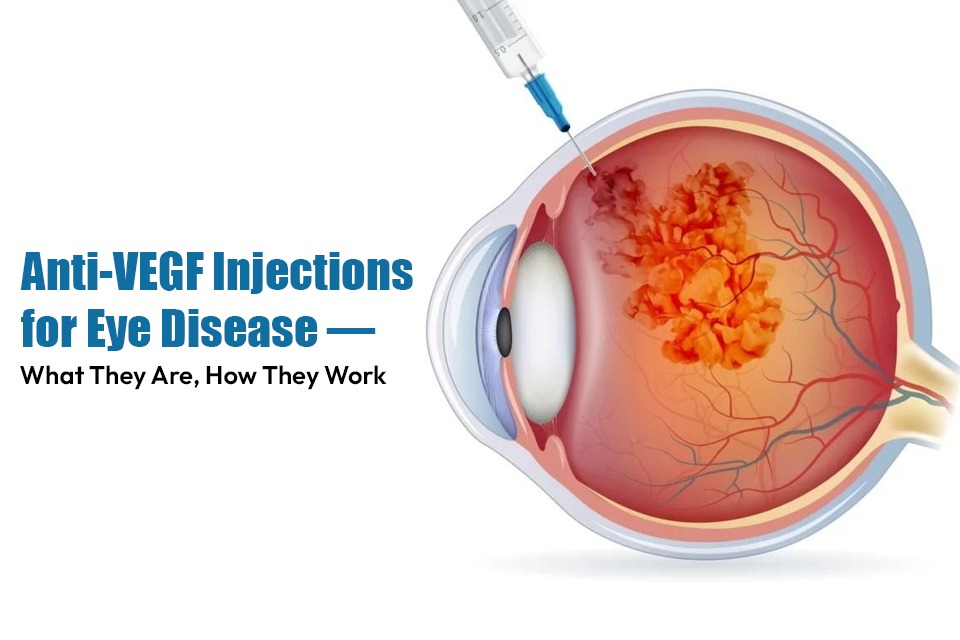
Your eye doctor has just told you that you need an injection in your eye. Your first reaction is probably discomfort, confusion, or even fear. An injection — in the eye? Why? Is it safe? Will it hurt? How many will I need?
These are completely natural questions, and you deserve clear, honest answers before you walk into the procedure room.
At Susanjeevani Hospital, the best eye hospital in Lucknow, anti-VEGF injections are one of the most commonly performed and most effective treatments we offer for serious retinal conditions. Every week, patients come to our eye clinic in Lucknow for this procedure — and the vast majority leave with significantly improved vision or with their vision successfully protected from further deterioration.
This blog explains everything about anti-VEGF injections in simple, plain language — what they are, how they work, which conditions they treat, what the procedure feels like, and what you should expect during and after treatment. Read it fully before your appointment. It will make the whole experience far less daunting.
What Does VEGF Mean and Why Does It Matter for Your Eyes?
VEGF stands for Vascular Endothelial Growth Factor. It is a protein naturally produced by cells in the body. In healthy amounts, VEGF plays a useful role — it helps new blood vessels form, which is important during growth and wound healing.
The problem begins when VEGF is produced in excessive amounts in the eye. When this happens, it triggers the growth of abnormal, fragile new blood vessels in the retina — the light-sensitive layer at the back of your eye that is responsible for your central vision.
These abnormal vessels are weak and leaky. They bleed into the retinal tissue, cause swelling, and damage the photoreceptors — the cells that actually convert light into the images you see.
Once these photoreceptors are damaged, the vision loss is permanent. This is why early treatment is so critical.
Anti-VEGF injections work by blocking this protein. They are medicines that, when injected into the eye, neutralise excess VEGF — stopping the growth of abnormal vessels, reducing leakage, and allowing the swelling in the retina to resolve.
In many patients, this not only stops further vision loss but actually improves vision that had already deteriorated.
Which Eye Conditions Are Treated With Anti-VEGF Injections in Lucknow?
Anti-VEGF injections are used to treat several serious retinal conditions. At Susanjeevani Hospital, our vitreoretinal specialist uses this treatment for the following:
1. Diabetic Macular Oedema (DMO) — The Most Common Indication in Lucknow
Diabetic Macular Oedema is the swelling of the macula — the central part of the retina responsible for sharp, detailed vision — caused by leaking blood vessels in diabetic patients. It is one of the leading causes of vision loss in people with diabetes and is extremely common in Lucknow given the high prevalence of diabetes in Uttar Pradesh.
When blood sugar remains uncontrolled over years, it damages the tiny blood vessels in the retina. VEGF levels rise, causing these vessels to leak fluid into the macula. The result is blurred central vision that progressively worsens.
Anti-VEGF injections are now the first-line treatment for diabetic macular oedema. They significantly reduce macular swelling and in many cases restore meaningful vision that had been lost.
2. Proliferative Diabetic Retinopathy — When New Abnormal Vessels Grow
In advanced stages of diabetic retinopathy, the retina becomes so starved of oxygen that it releases large amounts of VEGF, triggering the growth of fragile new blood vessels across the retinal surface and into the vitreous gel. This is called proliferative diabetic retinopathy.
These new vessels bleed easily, causing vitreous haemorrhage — sudden, severe vision loss where patients describe their vision going dark or seeing a red or dark haze. They also form scar tissue that can pull on the retina and cause tractional retinal detachment.
Anti-VEGF injections are used in this condition — sometimes alone and sometimes in combination with laser treatment for diabetic retinopathy or advanced vitreoretinal surgery — to suppress the abnormal vessel growth before it causes irreversible damage. Understanding how diabetes affects your eyes at every stage is essential for diabetic patients in Lucknow.
3. Wet Age-Related Macular Degeneration (Wet AMD)
Age-related macular degeneration is a condition that affects the macula in older adults, causing progressive loss of central vision. There are two forms — dry and wet. The wet form, which involves abnormal blood vessel growth under the macula driven by excess VEGF, is the more aggressive and vision-threatening type.
Without treatment, wet AMD can cause severe central vision loss within weeks to months. Anti-VEGF injections are the gold-standard treatment for wet AMD globally — they stop the growth of abnormal vessels and in many patients significantly improve vision. Regular injections over months to years are typically required to maintain the benefit.
4. Retinal Vein Occlusion (RVO) — Blockage of the Retinal Vein
A retinal vein occlusion occurs when one of the veins draining blood from the retina becomes blocked. This causes a backup of blood and fluid, leading to retinal haemorrhages and macular oedema. The result is sudden blurring or loss of vision in one eye.
There are two main types — branch retinal vein occlusion (BRVO), where a smaller branch vein is blocked, and central retinal vein occlusion (CRVO), where the main retinal vein is blocked. CRVO typically causes more severe vision loss. In both cases, the macular swelling that follows is treated very effectively with anti-VEGF injections in Lucknow, which reduce fluid accumulation and help recover useful vision.
5. Choroidal Neovascularisation (CNV) from Other Causes
Abnormal blood vessel growth under the retina (choroidal neovascularisation) can also occur due to conditions other than AMD — including high myopia (severe short-sightedness), inflammatory conditions of the eye, and certain inherited retinal disorders.
Anti-VEGF injections are effective for CNV regardless of the underlying cause and are part of the vitreoretinal treatment toolkit at Susanjeevani Hospital, one of the few eye hospitals in Lucknow offering this level of specialised retinal care.
Which Anti-VEGF Medicines Are Used?
There are several anti-VEGF drugs used in ophthalmology worldwide. The most commonly used ones in clinical practice in India include:
Bevacizumab (Avastin) — originally developed as a cancer drug, it was one of the first anti-VEGF drugs used off-label in eye conditions. It is cost-effective and widely used.
Ranibizumab (Lucentis) — specifically developed and approved for ocular use. It is a smaller molecule than bevacizumab, designed to penetrate retinal tissue more effectively.
Aflibercept (Eylea) — a newer molecule that blocks VEGF more broadly and may last longer between injections in some patients.
Brolucizumab (Beovu) — one of the more recent additions, offering longer duration of action in certain conditions.
Your eye doctor in Lucknow will recommend the most appropriate drug for your specific condition, the stage of disease, and your individual clinical situation. The choice of drug is a medical decision based on multiple factors — not one you need to make yourself.
How Is the Anti-VEGF Injection Procedure Done? A Step-by-Step Guide
This is the section most patients want to read before coming in. Here is exactly what happens during an anti-VEGF injection at our eye hospital in Lucknow — described honestly and in plain language.
Step 1 — Pre-Procedure Assessment
Before your injection, your eye specialist will review your recent OCT scan and fundus images to confirm the current status of your retina and the need for injection.
If you have not had recent imaging, an OCT scan and/or Fundus Fluorescein Angiography will be done to assess the extent of retinal swelling or abnormal vessel growth before proceeding.
Step 2 — Eye Drops to Prepare the Eye
Antibiotic eye drops and dilating drops are applied to your eye before the procedure. These begin about 30 minutes before the injection.
The dilating drops allow your doctor to see the retina clearly, and the antibiotic drops reduce infection risk.
Step 3 — Anaesthetic Eye Drops — This Is What Prevents Pain
A local anaesthetic eye drop is applied to completely numb the surface of your eye. This is the key step that makes the procedure virtually painless for the vast majority of patients. The drop takes effect within a minute or two.
An anaesthetic-soaked cotton swab may also be held against the injection site for a short time to further numb the area.
Step 4 — Cleaning and Draping
The area around your eye is cleaned with a betadine solution to reduce infection risk. A sterile drape is placed around the eye.
A small instrument called a speculum may be used to gently keep the eyelids open so you do not accidentally blink during the injection.
Step 5 — The Injection Itself
The injection is given into the vitreous cavity — the gel-filled space inside your eyeball — through the white part of the eye (the sclera), at a precise location about 3.5 to 4 mm behind the limbus (the junction of the cornea and white of the eye).
The needle used is extremely fine. The injection takes literally two to three seconds.
Most patients feel a brief sensation of pressure — not pain. Some describe seeing a momentary flash of light or a brief dark spot in their vision as the medicine enters the eye. This is completely normal and passes within seconds.
The most common description from patients at Susanjeevani Hospital after their first injection is: "It was much less than I expected."
Step 6 — Post-Injection Care
After the injection, antibiotic eye drops are applied. Your vision may be slightly blurry immediately after the procedure — this is normal and typically clears within a few hours.
You will be given antibiotic eye drops to use at home for 3 to 5 days to prevent infection.
The entire visit — from arrival to leaving the hospital — typically takes 1 to 1.5 hours, though the injection itself takes only a few minutes.
Does the Anti-VEGF Injection Hurt?
This is the question every patient asks. The honest answer is: for most patients, the procedure is far less uncomfortable than they feared.
Because the eye surface is thoroughly numbed with anaesthetic drops before the injection, the actual needle entry causes minimal to no pain.
What most patients feel is a brief sensation of pressure or a mild stinging that lasts only a second or two.
The anxiety beforehand is typically far more uncomfortable than the procedure itself. At Susanjeevani Hospital, our eye specialist doctors take time to explain every step before doing it, which significantly reduces patient anxiety and makes the experience manageable even for patients who are particularly nervous.
Very occasionally, patients experience mild eye ache or a foreign body sensation for a few hours after the procedure — this is easily managed with simple pain relief if needed and resolves on its own.
How Many Injections Will I Need?
This is one of the most important questions — and the answer depends entirely on your specific condition, its severity, and how your retina responds to treatment.
For diabetic macular oedema: Treatment typically begins with a loading phase of 3 to 6 monthly injections, followed by monitoring and further injections as needed based on OCT findings. Some patients eventually need fewer injections over time as the condition stabilises.
For wet AMD: Anti-VEGF injections are a long-term treatment. Many patients require ongoing injections — monthly or every 6 to 12 weeks — for years to maintain vision. The frequency may reduce over time with newer drugs and treat-and-extend protocols.
For retinal vein occlusion: A loading phase of monthly injections is typical, followed by an assessment of whether further injections are needed based on macular OCT findings.
The most important thing to understand is this — stopping injections prematurely without your eye doctor's advice is the single most common reason patients lose the vision gains they achieved.
Regular follow-up at a trusted eye care hospital in Lucknow is essential.
At Susanjeevani Hospital, your treatment schedule is personalised based on your OCT results at each visit, not on a fixed protocol. This ensures you receive exactly the treatment your retina needs — no more and no less.
What Are the Risks and Side Effects of Anti-VEGF Injections?
Anti-VEGF injections are one of the safest surgical procedures in ophthalmology when performed by an experienced vitreoretinal specialist in a properly equipped and sterile environment.
Serious complications are uncommon but patients should be aware of them.
Common, Mild Side Effects
- Redness of the eye at the injection site — usually resolves within 1 to 2 days
- Mild irritation or gritty feeling for a few hours after the injection
- Temporary floaters or small spots in vision immediately after — caused by the medicine or tiny air bubbles entering the eye; these resolve on their own
- Mild subconjunctival haemorrhage — a small, red patch on the white of the eye that looks alarming but is harmless and resolves within 1 to 2 weeks
Serious But Uncommon Complications
- Endophthalmitis — infection inside the eye is the most serious risk, occurring in approximately 1 in 1,000 to 1 in 3,000 injections.
- Strict sterile technique, antibiotic drops, and choosing a well-equipped eye hospital in Lucknow matters enormously. Endophthalmitis requires urgent treatment and can cause severe vision loss if not managed immediately.
- Raised eye pressure — a temporary increase in eye pressure can occur after injection, usually resolving within an hour. Patients with pre-existing glaucoma need closer monitoring.
- Retinal detachment — extremely rare but possible. Symptoms include sudden increase in floaters, flashes of light, or a curtain coming across the vision.
- This is a medical emergency — visit the best eye hospital in Lucknow immediately if these occur.
- Traumatic cataract — extremely rare; caused by the needle inadvertently touching the lens during injection.
The risk of these serious complications is significantly reduced when the procedure is performed by an experienced vitreoretinal specialist using proper sterile protocols — which is the standard at Susanjeevani Hospital.
What to Do and Avoid After Your Anti-VEGF Injection
What You Should Do
- Use your prescribed antibiotic eye drops exactly as directed — typically 4 times a day for 3 to 5 days
- Wear sunglasses when going outdoors to protect the eye from dust and bright light
- Rest at home for the remainder of the day of the procedure
- Attend your follow-up appointment as scheduled — usually within 4 to 6 weeks — for an OCT scan to assess the response to treatment
- Contact Susanjeevani Hospital immediately at +91-8400868388 if you experience sudden worsening of vision, increasing eye pain, significant redness, or discharge after the injection
What You Should Avoid
- Do not rub your eye for at least a week after the injection
- Avoid swimming or submerging your face in water for at least a week
- Avoid dusty environments and heavy physical exertion for 2 to 3 days
- Do not use any eye drops other than those prescribed by your doctor
- Do not skip your follow-up appointment — the OCT result at follow-up determines whether your next injection is due
Is Anti-VEGF Injection Treatment Available at Susanjeevani Hospital in Lucknow?
Yes. Susanjeevani Hospital is one of the few eye hospitals in Lucknow with a fully established vitreoretinal care unit offering anti-VEGF injections in Lucknow as part of a comprehensive retinal treatment programme.
Dr. Mohit Khemchandani, our senior ophthalmologist and vitreoretinal specialist, has extensive experience in managing all conditions requiring anti-VEGF therapy — from diabetic retinopathy treatment in Lucknow to wet AMD, retinal vein occlusion, and choroidal neovascularisation.
Our in-house OCT and Fundus Fluorescein Angiography allow for precise monitoring of treatment response at every visit — so your treatment is always based on real, current data from your retina, not guesswork.
If you or a family member has been told you need an anti-VEGF injection, or if you have diabetes and have not had a retinal examination recently, we strongly encourage you to prepare for your eye consultation and book an appointment with our vitreoretinal specialist without delay.
OPD Timings: Monday to Saturday, 10:00 AM to 8:30 PM
Phone: +91-8400868388
Address: B 1/7 Mahanagar Extension, opposite Sahara India Centre, Kapoorthala, Lucknow — 226006
