B 1/7 Mahanagar Extension ( Opp. Sahara India Centre ), Kapoorthala, Lucknow - 226006

Mon - Sat: 10:00am to 8:30pm
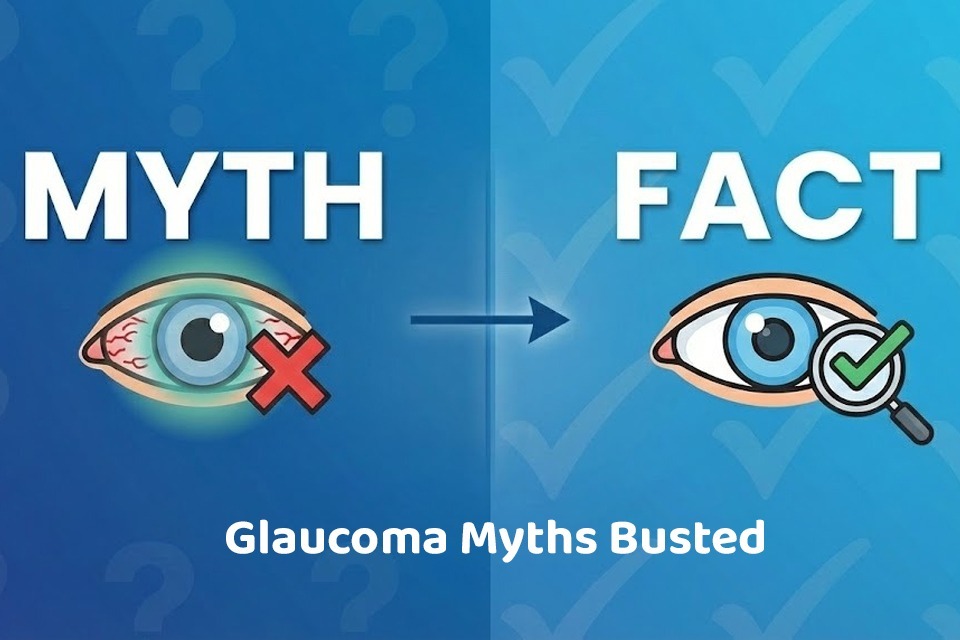
It is January, which means it is Glaucoma Awareness Month.
When you think of eye health, you probably think about needing glasses for reading or maybe getting cataract surgery when you are older. But there is a silent threat that many people ignore until it is too late. It is called Glaucoma.
Doctors often call Glaucoma the "Silent Thief of Sight". Why? Because it sneaks up on you without warning. It steals your vision slowly, and by the time you realize something is wrong, the damage is often permanent.
At Susanjeevani Hospital, we believe that awareness is the first step to prevention. There is a lot of wrong information floating around about this disease. Today, we are going to bust the top 5 myths about Glaucoma so you can protect yourself and your loved ones.
Understanding the Basics: What is Glaucoma?
Before we get to the myths, let’s understand what this disease actually is.
Glaucoma is a group of eye conditions that damage the optic nerve. The optic nerve is like a data cable that sends images from your eye to your brain. If this cable gets damaged, you can’t see the picture clearly.
Usually, this damage happens because of high pressure inside the eye. Your eye is filled with fluid. If this fluid cannot drain out properly, pressure builds up. This pressure pushes against the optic nerve and slowly kills the nerve fibers.
Now, let’s look at the things people think they know about Glaucoma, but are actually wrong.
Myth #1: "Glaucoma is an old person’s disease."
The Reality:
It is true that your risk increases as you get older. People over the age of 60 are at a higher risk. However, Glaucoma does not care about your birthday. It can affect anyone, from babies to young adults.
There is a type of glaucoma called Congenital Glaucoma, which happens in newborn babies. There is also Juvenile Glaucoma, which affects children and teenagers. Even people in their 30s and 40s can develop this condition.
Why this myth is dangerous: If you think you are "too young" to get it, you might skip your eye checkups. You might ignore small signs because you think, "I'm only 35, my eyes are fine." By the time you reach 60, you might have already lost significant vision that cannot be restored.
The Takeaway:Don't wait until you are a senior citizen to care for your eyes. Regular screening should start by age 40, or earlier if you have a family history.
Myth #2: "I have 20/20 vision, so I definitely don’t have Glaucoma."
The Reality:
This is one of the most dangerous myths. You can have perfect central vision, meaning you can read, drive, and see clearly straight ahead, and still have advanced Glaucoma.
Glaucoma usually affects peripheral (side) vision first. It damages the outer edges of your sight. Since we rely heavily on central vision for daily activities, the brain compensates by filling in the missing side vision, making everything seem normal.
You may read the eye chart perfectly during a basic vision test, yet still be losing side vision due to high eye pressure. By the time Glaucoma begins to affect central vision, the disease is often already at an advanced and serious stage.
The Takeaway: Good vision does not always mean healthy eyes. Passing a simple vision test is not the same as having a complete eye health examination.
Myth #3: "I would feel pain if my eye pressure was high."
The Reality:
Most forms of Glaucoma are completely painless.
The most common type, Open-Angle Glaucoma, develops very slowly over time as eye pressure builds up gradually. It does not cause headaches, eye pain, or redness. Your body does not send a pain signal like it would with a toothache or stomach ache.
There is one specific type called Angle-Closure Glaucoma which causes sudden, severe pain, nausea, and redness. But this is a medical emergency and is less common than the silent type. For the vast majority of patients, there are no early symptoms or pain. You can learn more about the specific types and symptoms of Glaucoma here.
Why this myth is dangerous: If you wait for pain before seeing a doctor, you may already be too late. Relying on pain as a warning sign can result in serious and permanent vision loss.
Myth #4: "If I get Glaucoma, the doctor can cure it and fix my vision."
The Reality:
This is an important but difficult truth: Vision lost due to Glaucoma is permanent and cannot be restored.
Unlike cataracts, which can be treated with surgery to improve vision, Glaucoma causes permanent damage to the optic nerve. Once nerve fibers are destroyed, they cannot regenerate. No medication, surgery, or eye drop can bring back lost vision.
However, Glaucoma can be managed. When detected early, doctors can control eye pressure using medications, laser treatment, or surgery. This helps slow or stop further damage and preserves the vision you still have.
The Takeaway: Early detection is the only way to protect your sight. You cannot recover lost vision, but you can prevent further loss.
Myth #5: "Testing for Glaucoma is painful and difficult."
The Reality:
Many people avoid eye checkups because they fear the tests. In reality, Glaucoma testing is quick, simple, and completely painless.
A comprehensive eye exam usually includes:
- Tonometry: Measures eye pressure using a gentle air puff or a light touch with a blue-light instrument. It does not cause pain.
- Ophthalmoscopy: Eye drops are used to widen the pupil so the doctor can examine the shape and color of the optic nerve.
- Perimetry (Visual Field Test): You look into a machine and press a button when you see small flashes of light. This test maps your side vision.
The entire process is non-invasive, takes very little time, and provides reassurance about your eye health for the year.
Who is at Risk?
Now that we have cleared the myths, it is important to understand who falls into the high-risk category. While Glaucoma can affect anyone, you should be extra cautious if:
- You are over 40 years old.
- You have a family history of Glaucoma (parents or siblings).
- You have diabetes or high blood pressure.
- You have high myopia (strong minus power in glasses).
- You have used steroid medications for a long period.
- You have had a previous eye injury.
If you fall into any of these categories, an annual eye checkup is mandatory, not optional.
Conclusion: Don't Guess, Get Checked
Your eyes are your window to the world. Losing vision can change your life forever. The most frightening part of Glaucoma is its silent nature, but the empowering truth is that it can be controlled if you take action in time.
January is the perfect time to make a health resolution. Do not let fear or myths stop you from visiting an eye specialist. If you are looking for the best eye hospital in Lucknow to keep your vision sharp and healthy for years to come, we are here to help.
At Susanjeevani Hospital, we use advanced diagnostic tools to detect eye pressure problems long before they affect your vision. Our Vitreo-Retina Specialist, Dr. Mohit Khemchandani, is highly experienced in managing complex eye conditions.
Remember, you only get one pair of eyes. Take care of them.
